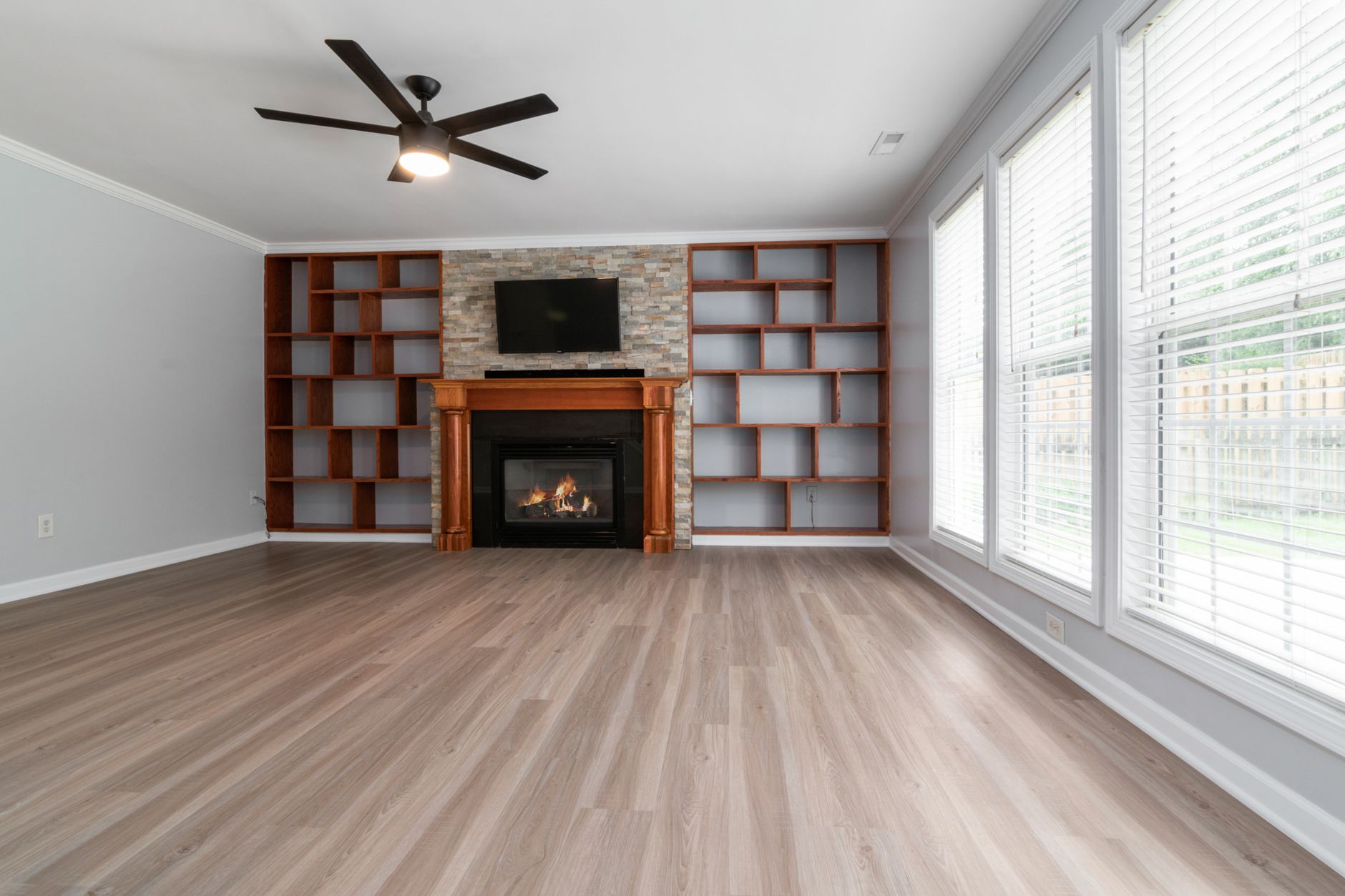
Floating vinyl plank is not attached to the subfloor, so when the subfloor shifts, shrinks, or settles a little, the plank layer slides a hair on its own and nothing cracks. Glue-down vinyl is bonded directly to that same subfloor, so whatever the subfloor does, the vinyl is forced to do with it — and vinyl does not stretch to keep up.
That single difference in attachment, not the vinyl itself, is why one product shrugs off the small movements every Missouri house makes and the other telegraphs them straight to the surface.
What is actually moving under a Missouri floor?
Almost nothing moves dramatically. Wood subfloors expand and contract a little with seasonal humidity. Concrete slabs expand and contract with temperature and continue curing — very slowly — for years after a pour. Older houses settle in small, uneven increments as soil under the footings finishes adjusting. None of this is the foundation failure a home inspector worries about; it is ordinary dimensional change, usually a fraction of an inch across a room.
A floor covering has to live with that fraction of an inch for the next 15 to 20 years. How it’s attached to the subfloor decides whether that movement is invisible or visible.
Why does a floating vinyl plank absorb that movement?
A floating floor is a continuous, interlocked layer that sits on top of the subfloor without being glued, nailed, or stapled to it. Planks click together at the edges and the whole field behaves as one connected sheet, with a small gap left at the perimeter under the baseboard. That gap is the entire mechanism: it gives the floor somewhere to expand into, and it means the floor is mechanically independent of whatever is happening underneath it.
When the subfloor shrinks slightly in winter or swells slightly in a humid Missouri summer, the floating plank layer doesn’t have to follow it exactly. It can shift as one connected unit, within the gap it was given, without any single plank being forced out of shape. The planks are locked to each other, not to the substrate — so the substrate’s movement and the floor’s movement are two separate events.
This is the same logic covered in more detail in Floating vs. Bonded Floors: What Decides a Missouri Job, which goes into how that choice gets made room by room, not just for vinyl.
Why does glue-down vinyl fail where plank does not?
Glue-down vinyl — sheet or tile — is bonded to the subfloor across its full surface. There is no gap, no slip layer, no independence. The adhesive’s entire job is to make the vinyl and the substrate move as a single unit, and for the first several years that’s exactly what happens.
The trouble starts when the substrate does something the vinyl can’t follow elastically. A hairline crack opens in a slab. A plywood seam shifts a sixteenth of an inch. A moisture swing causes uneven expansion across a large room. Because the vinyl is locked down everywhere, it has no room to redistribute that stress. It shows up instead as:
- Peaking or ridging along seams, where two edges are pushed into each other
- Tenting, where the vinyl lifts in a straight line over a crack below it
- Telegraphing, where a joint or crack in the subfloor becomes visible through the vinyl’s surface over time
- Bond failure at the edges, where the adhesive gives up before the vinyl itself does
None of this is a manufacturing defect in the vinyl. It’s the direct, physical consequence of gluing a thin, dimensionally stable material to a substrate that isn’t perfectly dimensionally stable itself. The vinyl is doing exactly what a bonded material is supposed to do — moving with its substrate — and that’s precisely the problem when the substrate moves unevenly.
Does this mean glue-down vinyl is the wrong choice?
Not for every room, and not categorically. Glue-down vinyl has real advantages that floating plank doesn’t: a fully bonded floor has no air gap to flex under heavy point loads, it tolerates rolling carts and wheeled equipment better, and it can be built with a fully welded, waterproof seam in commercial-grade sheet goods. That’s why it shows up in clinics, kitchens with heavy rolling traffic, and some basements.
The decision isn’t “floating is better.” It’s whether the substrate underneath is flat, dry, and dimensionally settled enough to trust with a permanent bond. A slab that has fully cured, is level within tolerance, and isn’t actively cracking is a reasonable candidate for glue-down. A subfloor in a house where the soil is still settling, or a slab with visible movement already, is a much weaker bet for a bonded product — and a much better candidate for a floating install instead.
How to Measure Floor Flatness With a 10-Foot Straightedge is the practical first step before committing either way, because flatness and stability are the two things a glue-down installation can’t make up for later.
Where does floating vinyl plank not belong?
Floating floors have their own limits, and a site that only praised vinyl plank wouldn’t be telling the reader anything useful. Floating plank is the wrong answer in:
- Very large unbroken runs — beyond a manufacturer’s stated width and length limits, the floating layer can accumulate more expansion than the perimeter gap and transitions can absorb
- Rooms with heavy rolling loads, like a garage workspace or a room doubling as a shop, where a bonded surface resists point-load flex better
- Spaces that need a fully welded, seamless waterproof membrane, which is a sheet-goods, glue-down specialty, not a click-together one
- Rooms where the subfloor itself is badly out of flat — a floating floor still needs a reasonably flat surface underneath it, it just doesn’t need a bonded one
Vinyl plank in general — floating or glue-down — also isn’t the right call in every room of a house. The materials hub covers where each of the eight common flooring materials is strong and where it isn’t, and the room-by-room hub ranks rooms by how hard they actually are on a floor, which is a better starting filter than brand loyalty to one material.
What does this cost, and which number actually moves?
Installed luxury vinyl plank runs $2 to $12 per square foot in Missouri, and that is a planning range, not a quote — the final number on any specific project depends on the plank grade, the room’s layout, and what the subfloor needs before installation can start. A floating install and a glue-down install of comparable plank don’t usually differ much in material cost; the spread comes from labor and from what the subfloor requires first.
Labor is also the part of the price that moves by region. Material for vinyl plank is a national commodity and costs close to the same whether it’s installed in Kansas City or the Ozarks. Labor is what swings — roughly 12% between the Kansas City metro at the high end and the Ozarks at the low end. The cost hub breaks that down by material and by city, and the cost estimator applies the regional multiplier to labor specifically, so a reader can see how much of a given quote is regional and how much is simply the job.
Four line items decide whether a vinyl plank quote is complete, and they’re the same four regardless of floating or glue-down: the per-sheet rate for replacing damaged subfloor decking, the cut-and-waste allowance and who keeps the offcuts, removal and disposal of whatever floor is coming out, and the transitions and thresholds where the new floor meets another room. The quote hub walks through all four. Removing an old floor generally runs $1 to $4 per square foot on its own, again as a planning range tied to the specific material coming out and what’s underneath it.
How does house age factor into this decision?
Housing age doesn’t say anything about what a house is worth, but it is a reasonable clue to whether the ground underneath it has finished settling. Newer construction on engineered fill is more likely to still be making small adjustments in its first years. Older housing stock has generally had decades to finish that process, though an older house can also carry its own history of additions, repairs, or a basement slab poured at a different time than the rest of the structure.
St. Louis has a median year built of 1938, with 57.9% of its housing stock predating 1940 — among the oldest stock of any Missouri city tracked here. Kansas City’s median is 1969, with 21.3% pre-1940. O’Fallon, at the other end, has a median year built of 2000 and only 0.8% of its housing predating 1940. None of that tells a reader what to install. It tells a reader which question to ask before choosing floating versus bonded — and whether the slab or subfloor in a specific house is more likely to still be settling or long past it. The city-by-city hub lays out the housing stock for all ten cities this site covers, and the Old Missouri Houses archive goes deeper into what that age actually changes about a flooring job.
What should a reader actually check before choosing between the two?
Before picking floating or glue-down vinyl plank, the practical checks are the subfloor’s flatness, its dryness, and its stability — not the look of either product, since modern vinyl plank in both installation styles can be visually identical. A flat, dry, and settled substrate can support either method. A substrate that’s still moving, or isn’t flat to begin with, is a much stronger argument for floating.
If the existing floor is being replaced rather than installed over bare subfloor, that decision starts earlier. The refinish-or-replace hub covers how to judge whether what’s already down is worth keeping, which changes what the subfloor looks like once the old material comes up. And because preparation work is the part of a flooring job that’s invisible once it’s finished but decides how the floor behaves for years afterward, the installation and prep archive is worth reading before signing off on either a floating or a glue-down quote.
Testing a slab for moisture, checking a subfloor’s flatness against manufacturer tolerance, and confirming whether a municipal permit applies to the specific scope of work are all steps a reader’s own contractor, testing lab, or local building department should confirm directly — those answers are local and project-specific, not something a general article can settle in advance.
MOFloors is an independent Missouri flooring resource. We do not sell or install flooring, we do not quote jobs, and nobody from this site will call you. Cost figures here are published planning ranges for Missouri, not quotes — what you actually pay depends on your rooms, your subfloor and the material you choose, and the final price depends on your project. Photography is licensed stock used to illustrate materials and rooms; it is not work by anyone connected to this site. Building code and permit requirements are enforced locally in Missouri, so confirm anything regulatory with your own municipality before you rely on it.
Any prices mentioned are indicative only. Tool prices move constantly and vary by market, by retailer, and by whether a kit includes batteries or a charger — check the current price yourself before deciding.
Featured image: Photo by Curtis Adams via Pexels.