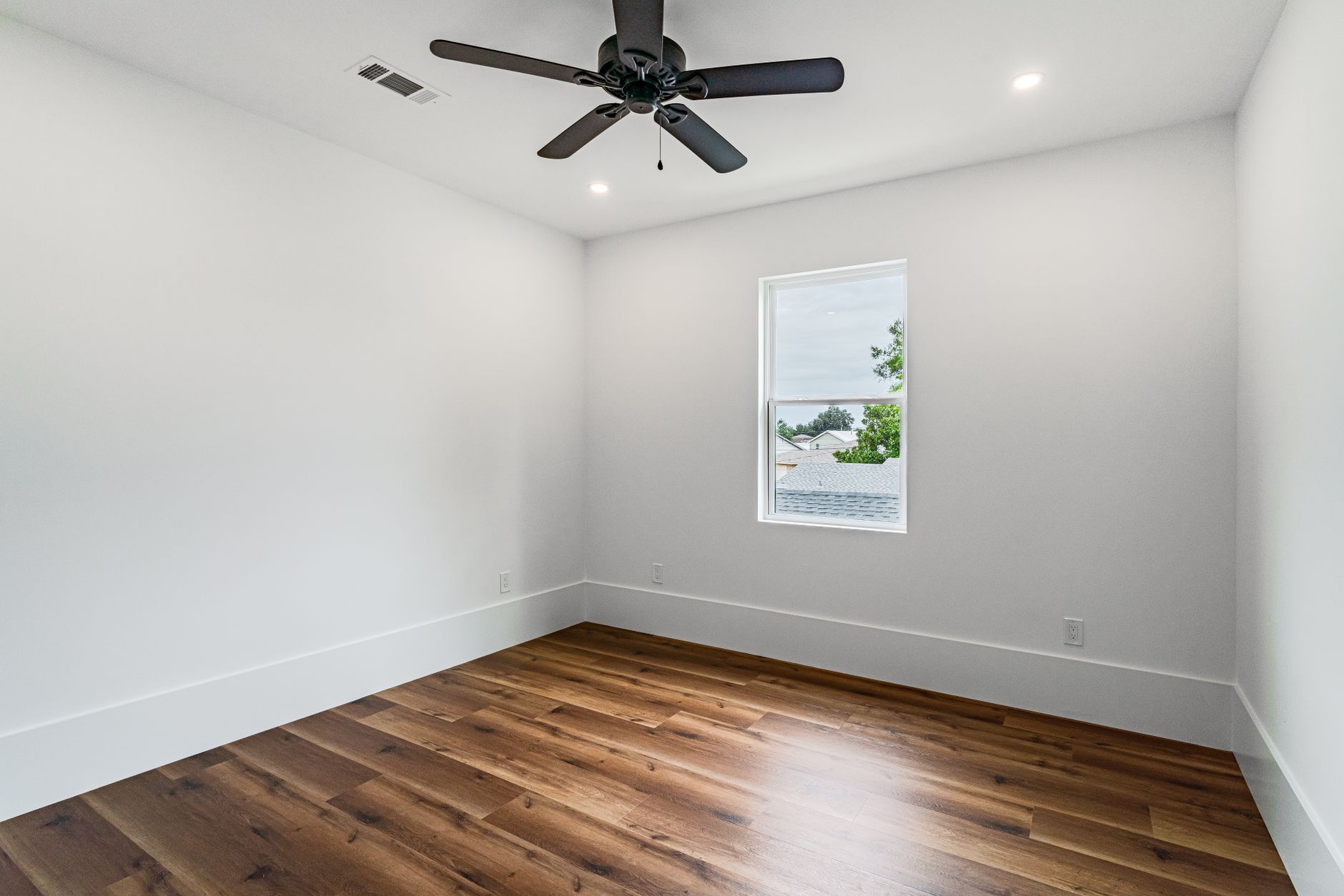
Hardwood Flooring Installation in Missouri: Costs and Movement
Hardwood is the floor most affected by what is underneath it, because it is fastened to the subfloor rather than floating over it — which makes the flatness question the first one, not the last.
What it costs
Installed hardwood in Missouri generally runs $6 to $22 per square foot. Prefinished oak strip in a straightforward rectangular room sits near the bottom; wide-plank white oak, site-finished, over a subfloor that had to be leveled first sits near the top. A herringbone or chevron layout adds materially to labor because of the cutting and the waste.
An estimate, not a quote. These are planning ranges for Missouri, not a quote. What you actually pay depends on your rooms, your subfloor and the material you choose.
Solid or engineered, and why it matters here
Solid hardwood is nailed to the subfloor, so it follows every movement the subfloor makes. Engineered hardwood has a plywood core that is dimensionally more stable across its width, and — more usefully in Missouri — it can be floated rather than glued or nailed. A floating floor is not attached to the substrate at all: it rides on it, and small seasonal movement passes underneath instead of into it.
That is the practical difference on ground that is still settling. In an older house that has found its level, either works once the floor is flat. In a newer house on graded clay fill, a floated engineered floor is the more forgiving assembly.
Flatness before anything else
Most manufacturers specify about 3/16 in over 10 ft for plank, and the warranty is written around it. Lay a ten-foot straightedge on the floor and measure the largest gap underneath. If it fails, the fix is leveling compound or self-leveling underlayment, and that belongs in the quote as its own line before anyone starts — not as a surprise on the second morning.
Acclimation
Hardwood has to sit in the room it is going into, at the humidity it will live at, before it goes down. Missouri swings from humid summers to dry heated winters, and boards laid at the wrong moisture content shrink or cup after the crew leaves. “The boxes were on site for 48 hours” is storage, not acclimation — ask what moisture content the installer is targeting and how they measured it.
Common questions
Is there already hardwood under my carpet?
It depends almost entirely on when the house was built. St. Louis is 57.9% pre-1940 and St. Joseph 27.5%, so in that housing it is a live possibility. In O’Fallon at 0.8% and Blue Springs at 1.6%, there is nothing under there but subfloor. Lifting a corner in a closet settles it in two minutes.
Will gaps open in winter?
Small seasonal gaps are normal in any wood floor in this climate and they close again in summer. Wide plank shows them more than strip, because the same percentage of movement is spread across fewer joints.
Which direction should the boards run?
Along the longest wall or toward the main light, and across the joists rather than parallel to them if the subfloor is boards rather than plywood.