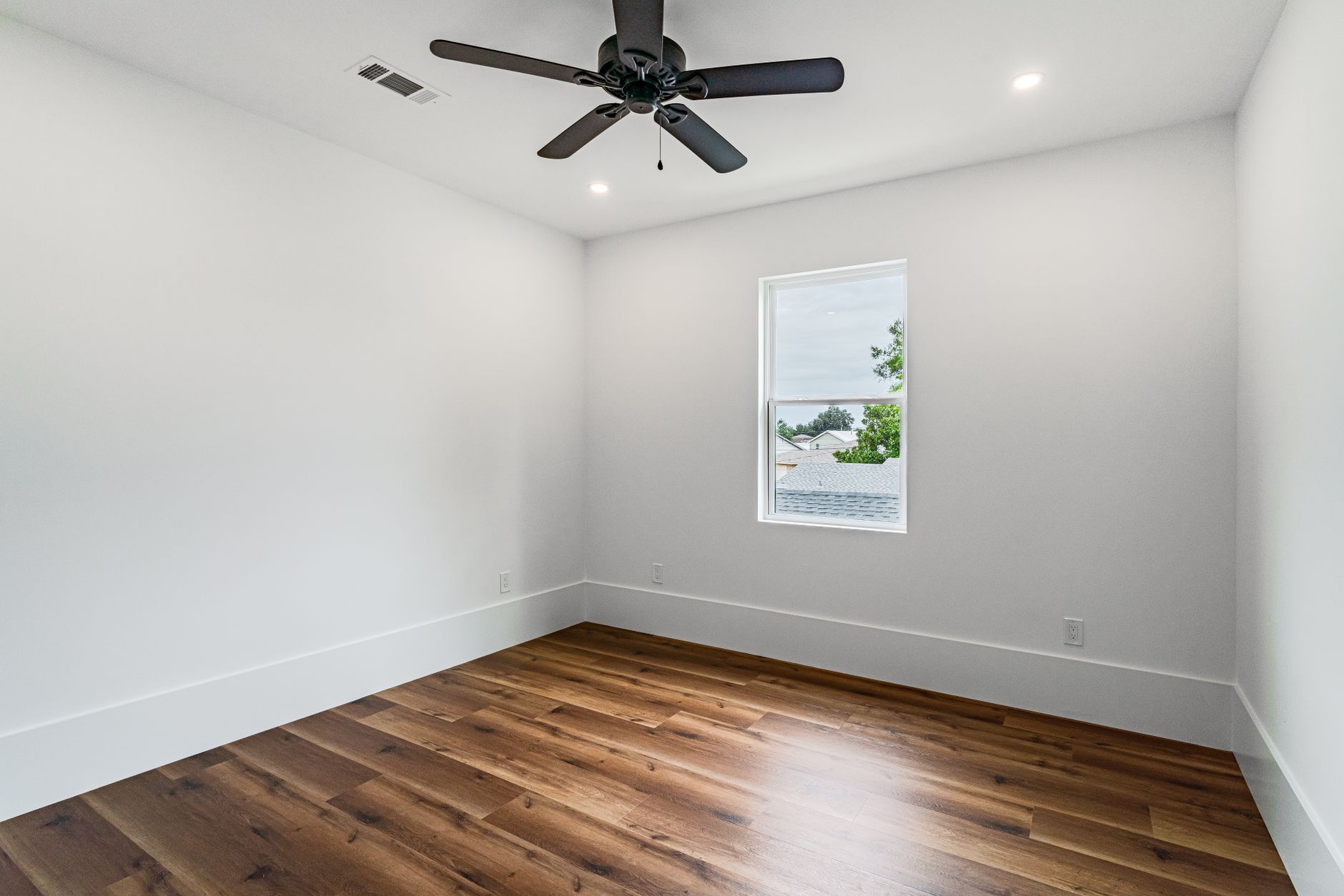
Flooring in Blue Springs, Missouri
The median Blue Springs home was built in 1986, and 1.6% of them predate 1940. That is what decides your floor here.
What Blue Springs's housing stock does to a floor
Blue Springs is 1.6% prewar against a 1986 median — modern suburban almost throughout, built on Jackson County clay that was cut and filled to make the lots. That is the classic still-moving case: nothing here is old enough to have finished its cycles, and a rigid floor laid over ground that is still traveling is the one combination this site tells you to avoid.
Unusually for Missouri, Blue Springs and Jackson County are close in age — 1986 against 1974 — so the housing you find in the city is broadly the housing you find around it. That makes the material advice on this page unusually portable across the wider area.
Neighborhood to neighborhood this varies, and around Adams Farm, Woods Chapel, Chapel Ridge and Lake Tapawingo you will find a real spread of build eras inside a few miles. The figures below are the city-wide picture; your own block may sit either side of it.
| Measure | Blue Springs | Missouri |
|---|---|---|
| Median year built | 1986 | 1978 |
| Built before 1940 | 1.6% | 13.3% |
| Surrounding county median | 1974 | — |
Housing figures for this page: U.S. Census Bureau, American Community Survey 2020–2024 5-year estimates, tables B25034 and B25035.
What flooring costs in Blue Springs
Installed ranges, materials and labor together, with Kansas City metro labor rates applied. Material prices are national and do not move with your address; labor does, which is why only that half of each figure is adjusted.
| Work | Per sq ft, installed |
|---|---|
| Hardwood, installed | $6 – $22 |
| Refinishing existing boards | $3 – $8 |
| Luxury vinyl plank, installed | $2 – $12 |
| Carpet, installed | $2 – $8 |
| Tile, installed | $9 – $15 |
| Laminate, installed | $3 – $9 |
An estimate, not a quote. These are planning ranges for Missouri, not a quote. What you actually pay depends on your rooms, your subfloor and the material you choose.
For a number against your own room rather than a band, the cost estimator takes your dimensions, your material and your conditions and shows the working. It is free, it needs no email, and nobody calls you.
Blue Springs flooring services
- Hardwood Flooring Installation in Blue Springs
- Hardwood Floor Refinishing in Blue Springs
- Luxury Vinyl Plank Flooring in Blue Springs
- Carpet Installation in Blue Springs
Every material we cover, with what it costs installed in Missouri and where it is the wrong answer, is on the materials index.
Before you start, in a house this age
With 1.6% of Blue Springs homes built before 1940, three checks are worth doing before you choose anything:
- Look under the carpet. Narrow-strip oak was standard here and a great deal of it survives. Refinishing usually costs about a third of replacing.
- Find out what the subfloor is. Plank or plywood changes the price of every material except solid hardwood and carpet. How to check in five minutes.
- On a newer house, get the slab tested. An in-situ RH probe at 40% of slab depth, read after 24 hours. Below roughly 75–80% and wood is on the table; above it, deal with that first. How the test works.
And when you are comparing quotes, ask what the slab measured and what the moisture meter read on the boards. In Missouri, carpet and vinyl plank installation needs no license at all — the rule says so by name — so those two numbers tell you far more about an installer than a classification code does. What Missouri licenses, and what it does not.
Questions people actually ask
My floor is not level. Is that a problem?
Not by itself, and in Missouri it is common. The question is whether it is still moving. A house that settled decades ago has found its level: the floor can be brought flat with levelling compound and then take any material. A newer house on graded clay may still be working through its first seasonal cycles, and there the sensible answer is a floor that tolerates a little movement. Neither case means anything is wrong with the house.
Why does tile crack here and vinyl plank does not?
Because tile is bonded to the substrate and vinyl plank usually floats on it. A bonded assembly has to move exactly as much as whatever it is stuck to, and when it cannot, the stress goes into the grout and the tile. A floating floor is not attached, so small substrate movement passes underneath it. If you want tile over ground that moves, the answer is an uncoupling membrane and a properly flat substrate, and it is worth paying for both rather than hoping.
How flat does my floor actually need to be?
Most plank manufacturers specify around 3/16 in over 10 ft, and tile — particularly large-format — wants closer to 1/8 in over 10 ft. Lay a ten-foot straightedge on the floor and measure the biggest gap under it. That one measurement decides whether you are buying a floor or a floor plus a levelling job, and knowing it before you get quotes is worth more than any other ten minutes you will spend.
Does the whole state have this problem?
No, and the difference is worth knowing. The heaviest expansive clay runs through the western counties, from Kansas City south. St. Louis sees it mostly through clay backfill around foundations. Central Missouri transitions to loess and glacial deposits with moderate shrink-swell. Springfield and the Ozarks trade it for shallow bedrock and chert, which is a different substrate problem rather than the same one.
Should I level the floor or just lay over it?
It depends on how far out it is and what you are laying. Small deviations disappear under carpet and are tolerated by most floating floors. Anything approaching the manufacturer's tolerance needs correcting first, and anything bonded — tile, stone, glued plank — needs it correcting properly. Laying a rigid floor over a substrate that fails the flatness spec is the single most common way a new floor fails early.
Do flooring installers in Missouri need a license?
Missouri has no statewide contractor license. Licensing is local, and cities including St. Louis and Kansas City run their own registration schemes, so requirements depend on where the work is. That is a footnote rather than a test: flooring is finish work, and an installer without a state license is the normal case here, not a warning sign. What actually separates two quotes is whether the installer measured the floor.